

Risk Considerations
Investors should note that the Xtrackers ETFs are not capital protected or guaranteed and investors in each Xtrackers ETF should be prepared and able to sustain losses up to the total capital invested. The value of an investment in an Xtrackers ETF may go down as well as up and past performance does not predict future returns. Investment in Xtrackers ETFs involve risks. For a list of related risks please click on the Risks and Terms tab.
Important security note: Warning of attempted fraud in the name of DWS
We have detected that fraudulent individuals are misusing the "DWS" trademark and the names of DWS employees on the internet and social media. These fraudsters are operating fake websites, Facebook pages, WhatsApp groups and Mobile Apps. Please be aware that DWS does not have any Facebook Ambassador profiles or WhatsApp chats. If you receive any unexpected calls, messages, or emails claiming to be from DWS, exercise caution and do not make any payments or disclose personal information. We encourage you to report any suspicious activity to info@dws.com, including any relevant documents and the original fraudulent email. Additionally, if you believe you have been a victim of fraud, please notify your local authorities and take steps to protect yourself.
Welcome to the September Edition of Xtrackers Spotlight!
This month, we turn the spotlight on Germany, where the gap between bleak headlines and hard data has rarely been wider – or is pessimism simply Germany’s default setting? Looking at the actual fundamentals, we explore why leading indicators, a new investment cycle and a far-reaching reform agenda paint a better picture than one might expect – for Germany, and by extension for Europe.

Gloomy news, but growing order books
Anyone looking to paint a grim picture will find ammunition in the latest headlines: the number of unemployed has climbed above three million, and at 6.4 percent Germany's unemployment rate is back at its pandemic peak.[1] Add Deutsche Bahn, the state-owned railway, where fewer than six in ten long-distance trains ran on time in the first half of 2026.[2] Yet these headlines do not necessarily show the full picture. First, unemployment is a lagging indicator. Second, the direction of travel seems to have changed. After three years of stagnation, real GDP has grown for three consecutive quarters, and in the first half of 2026 growth ran at an annualised 1.2 percent – only modestly behind the U.S., which recorded 1.5 percent in the second quarter, lifted by a massive AI investment cycle: a tailwind the old continent largely went without.[3]
And there could be more ahead: leading indicators such as industrial orders are running around 6 percent above their level a year ago – the strongest order growth since 2016/17 if the post-pandemic rebound is excluded – while production has yet to follow (see chart below). This growing backlog forms a pipeline of activity that typically feeds into production with a lag, suggesting the strongest phase of the recovery may still lie ahead.[4]
A gap pointing to growing industrial output
German manufacturing: new orders vs. industrial production, index (2021 = 100), 6-month moving averages (new orders on the right axis)
Source: DWS International GmbH, Haver Analytics Inc., as of 06/2026. Period: 01/2010 to 04/2026. Past performance is not a reliable indication of future performance.
Why this turn could be more than a bounce
This rather benign outlook is underpinned – and could be amplified – by three developments we see as particularly relevant.
1 Big wave ahead? Most of the announced funds are yet to be deployed
Of Germany's €500bn Infrastructure and Climate Neutrality Fund – around 11 percent of GDP – only €51bn[5] has been spent so far.[6] Defence spending, meanwhile, is set to climb from more than €108bn in 2026 to around €152bn by 2029.[7] The Bundesbank already expects a fiscal impulse of around 1.5 percent of GDP in 2026 – exceptional by German standards. A fair question is how much of this will actually reach the real economy. While investment-led stimulus is slower to unfold than consumption-led spending, its effects tend to be more persistent – which we consider a positive. Also, Germany is not investing alone: similar programmes are underway across Europe, from investments in grids to defence as well as digital infrastructure. For the German industry, traditionally strongly geared to Europe's investment cycles, that adds a second source of demand.[8]
2 Agenda 2010 revisited?
Additional support is expected from Berlin: the 34-point reform package presented in July targets well-known weaknesses – bureaucracy, underinvestment and labour shortages. One telling example is that implementation times for new electricity grid projects are set to be halved. If and when progress becomes visible, broader investor confidence could follow. The last reform push of this scale, the ‘Agenda 2010’, was followed by years of German equity outperformance – aided, admittedly, by booming exports to China.[6] Still, markets may be underestimating the long-term positive effects of the current reform agenda.
The Agenda 2010 was followed by years of outperformance in German equities
Performance of MSCI Germany index and MSCI Europe ex Germany index before and after introduction of Agenda 2010 reform package (indexed at 100 on 31.03.2003)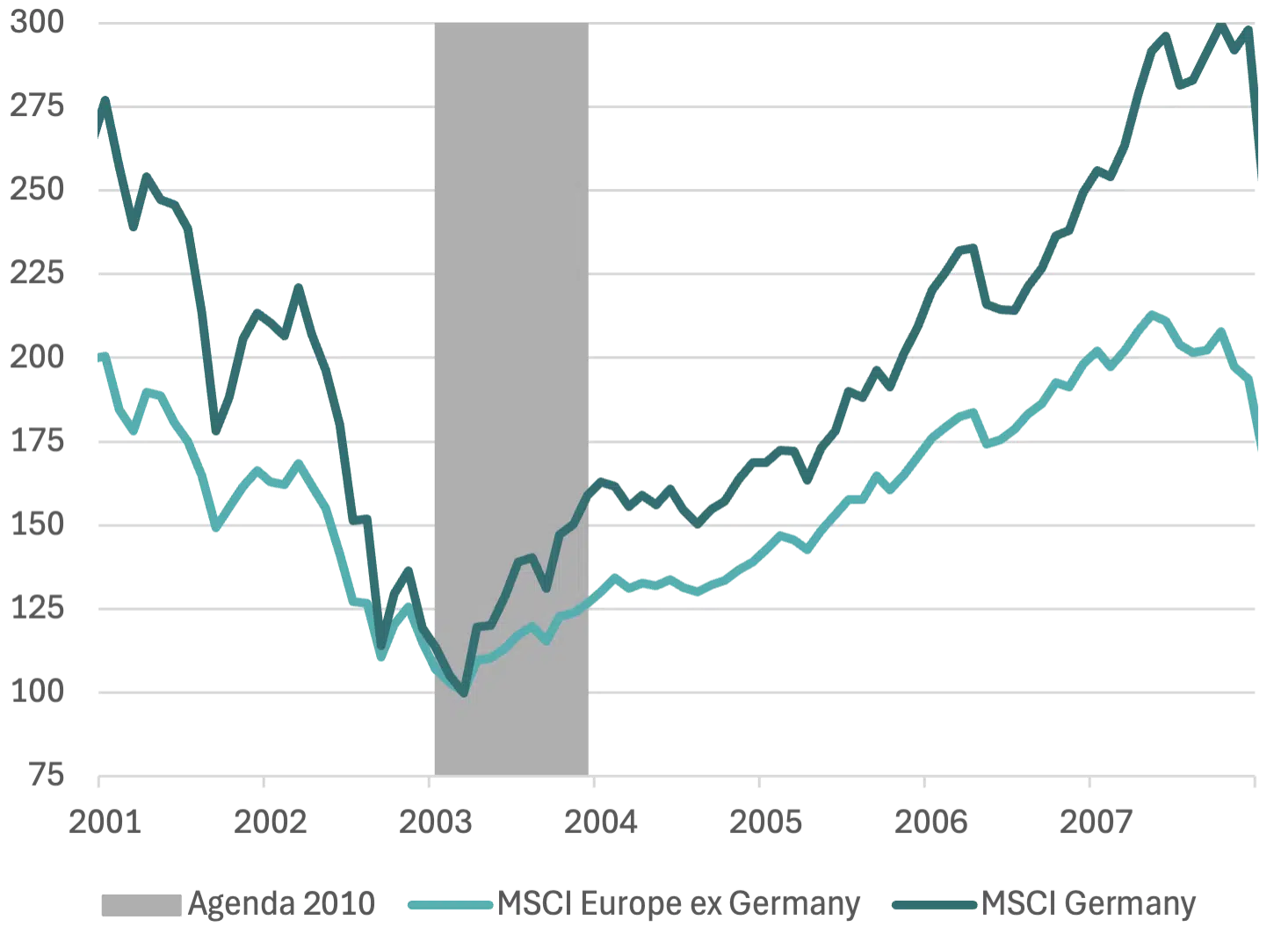
Source: DWS International GmbH, data as of end-June 2026
3 Flows still snub benign performance
Meanwhile, the strong relative performance of European stocks has gone largely unnoticed by investors. Since the start of 2025, the STOXX Europe 600 has gained around 34 percent and the DAX around 30 percent in euro terms – well ahead of the S&P 500 at roughly 18 percent in the same time frame.[9] Only Japanese and emerging markets equities have done better. Their momentum, however, has subsided in recent months, while German and European indices have picked up pace – a shift that may still have room to run.
Year-to-date net flows, however, follow the familiar pattern of previous years – perhaps distracted by shinier narratives. U.S. equities attracted €66bn, whereas European equities, at €18bn, rank only third behind emerging markets (€21bn). As a matter of fact, German stocks even suffered slight outflows.[10]
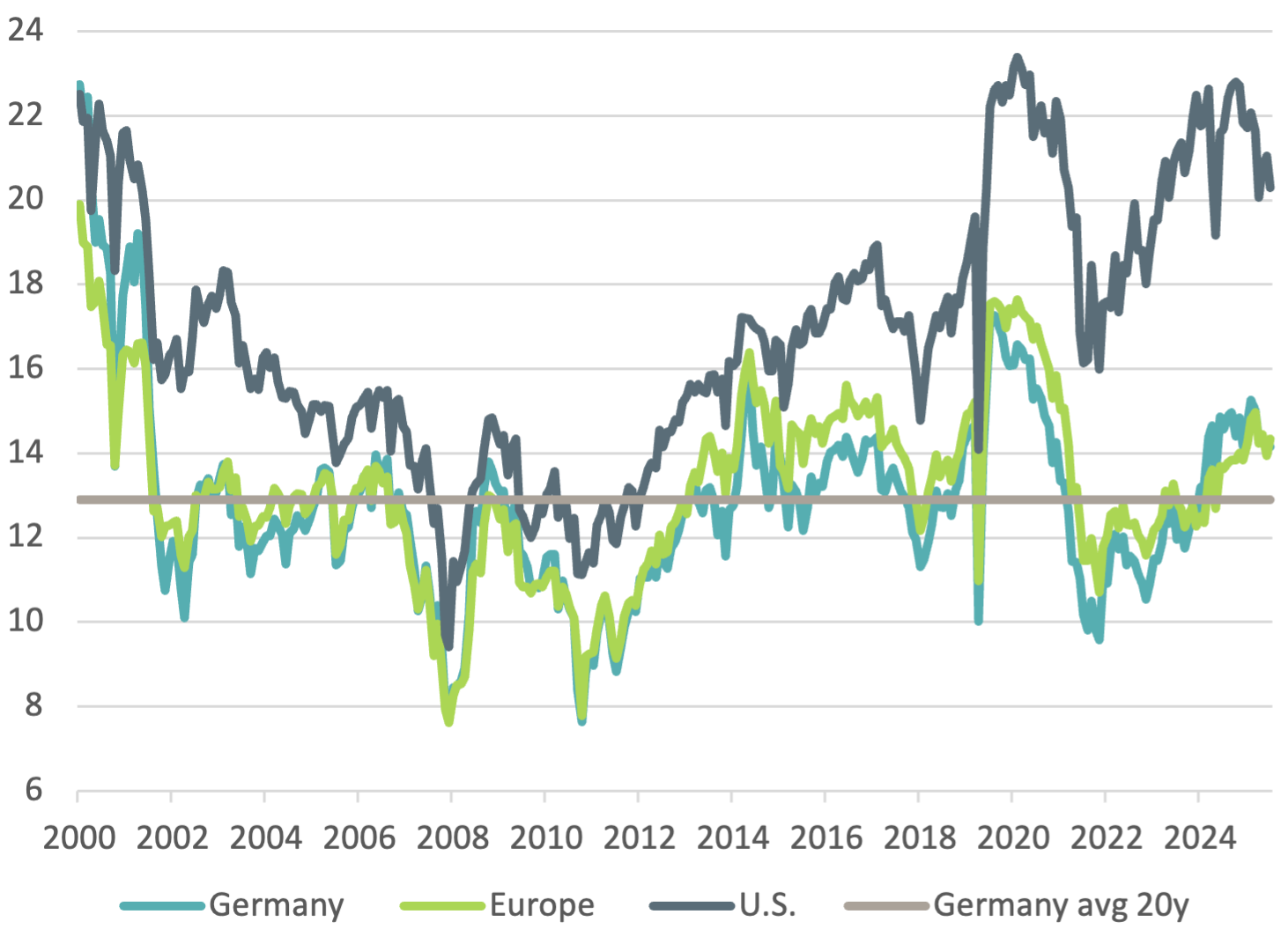
Last but not least, valuations complete the picture: at around 14x forward earnings versus roughly 20x in the U.S., German and European equities do not carry the lofty multiples seen across the Atlantic (see chart below) – a different risk profile, with potentially less downside should the AI excitement cool at some point. Even though German equities may no longer be cheap relative to their own 20-year average, multiples climbed well above today’s levels in earlier recovery phases – which leaves room to the upside if the recovery gains traction.[11]
Less lofty multiples on this side of the pond
12-month forward price-to-earnings ratios: Germany, Europe and the U.S., and Germany's 20-year average
Source: LSEG, DWS Investment GmbH, as of 06.07.2026. Period: 01/2000 to 07/2026. 12-month forward price-to-earnings ratios based on consensus earnings estimates. Forecasts are based on assumptions, estimates, views and hypothetical models or analyses, which might prove inaccurate or incorrect.
For more insights on Germany's economy and the gap between sentiment and data, see our CIO Special ‘Germany: Better than sentiment suggests’. For a deeper dive into the reform agenda and valuations, see ‘Berlin's undersold big reform package’. And for the broader European picture, see our research paper ‘Europe's Edge in 2026’.